
Rather than hand the crown to whatever theme has the biggest install number or the longest feature list, I’m going to define what that phrase actually has to mean, then hold every contender to it. This article delivers a verdict built on testing and evidence, judged across longevity, real user adoption, performance, flexibility, compatibility, development history, free-version usefulness, premium value, WooCommerce support, and the ability to stay relevant as WordPress itself has changed.
So before any comparison happens, the standard comes first. A theme with a million installs can still be a poor choice today, and a feature-packed multipurpose theme can crumble under its own weight. The three finalists here each represent a genuinely different philosophy: Astra stands for scale and flexibility, GeneratePress for minimal, performance-first foundations, and Blocksy for modern customisation. What ties them together is the harder question underneath the headline. Calling something the best WordPress theme ever only counts if it would still be a strong pick for someone installing it right now. Historical significance alone doesn’t earn that, and neither does nostalgia. The winner has to survive both the past and the present.
Three Contenders That Still Earn Their Place Today
Astra, GeneratePress, and Blocksy are my three finalists, and each one is a genuinely different answer to the same problem. One bets on scale and flexibility, one on a lightweight foundation, and one on modern built-in control.
| Astra | GeneratePress | Blocksy | |
|---|---|---|---|
| Active installations | 1+ million | 500,000+ | 300,000+ |
| WordPress.org rating | 4.9/5 | – | 5/5 |
| Latest theme update | September 24, 2026 | December 1, 2025 | September 2026 |
| WooCommerce support | Yes | – | Advanced support |
| Builder/editor compatibility | Elementor, Beaver Builder, Spectra | – | Block editor |
The table needs one clarification before I move on. GeneratePress’s sub-10 KB gzipped figure is the developer’s own claim about a fresh installation, not something I’ve measured. I’ll treat it as a claim to be tested rather than a fact to be repeated, and the independent testing comes later in this piece.
Astra’s case starts with its install base, but that number is a symptom rather than the argument. What actually holds it up is survival. It has weathered the major shifts WordPress has gone through while staying useful to beginners, agencies, ecommerce sites, and page-builder users at the same time.
GeneratePress comes at the problem from the opposite direction to the feature-heavy multipurpose themes. Its whole pitch is a reliable, lightweight foundation, with users adding only what they actually need rather than switching off features they never asked for. On the update question, I’ll be plain: its WordPress.org listing currently shows December 1, 2025 as the latest theme update, and a gap in updates is not by itself evidence of abandonment.
Blocksy is the youngest of the three, so its case for being among the greatest WordPress themes rests less on longevity and more on execution. It pairs performance-focused foundations with considerably more built-in visual control than the other two offer out of the box.
Why Historical Influence Alone Would Give a Different List
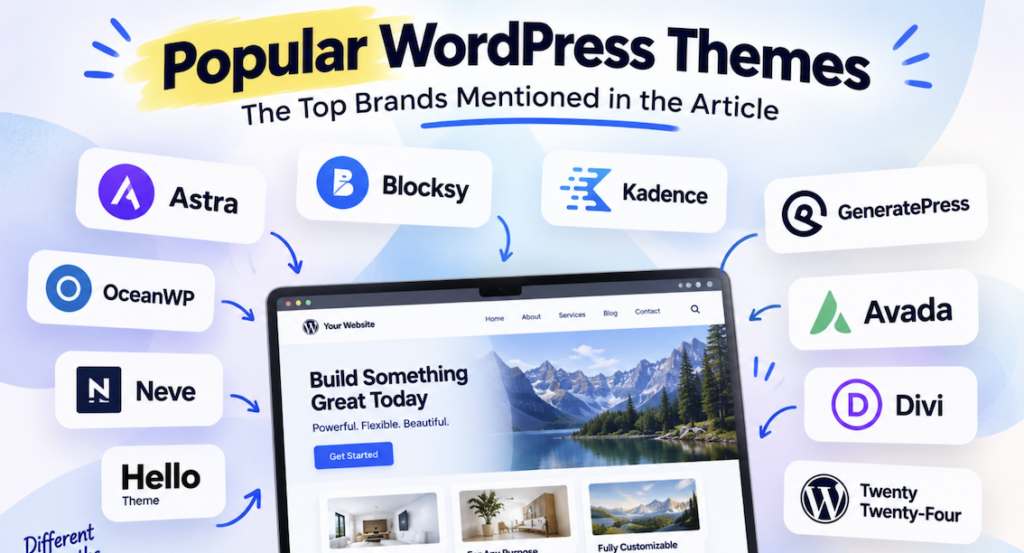
If I judged “best WordPress theme of all time” purely on historical influence, this would be a very different article. Divi would be in it. So would several of the other major multipurpose themes that shaped how people built sites for years. Those themes had enormous impact. They taught a generation of users that you could drag a page together without touching code, and they dominated the most popular WordPress themes lists for a long stretch.
But influence is not the same as usefulness, and I think the usual nostalgia-based ranking is the wrong exercise. It rewards what a theme did in the past and quietly excuses whatever it does now. A theme can be historically important and still be a poor choice for someone opening a fresh WordPress install this afternoon.
So the question I’m actually asking is harder: which historically significant theme would still be one of the best choices if someone installed it today? That single reframing changes who belongs in the top three. It rules out anything coasting on reputation alone, and it rules out anything too new to have a track record. Astra, GeneratePress, and Blocksy survive that filter, which is why they’re here instead of a lineup built on sentiment.
Here’s the standard I’m holding every contender to.
- It has survived major WordPress changes.
- It has maintained a substantial user base.
- It is still receiving meaningful development.
- It has avoided excessive lock-in.
- It remains practical for modern sites.
- It works across different website types.
- It provides reasonable performance.
- It maintains compatibility with the wider WordPress ecosystem.
That list pulls in two directions at once. A theme released six months ago can be technically superior and still fail, because it can’t demonstrate the same longevity. An older theme shouldn’t win just because millions of people installed it, either. The standard has to hold both ends at the same time, and most themes only satisfy one.
How We Tested Astra vs GeneratePress vs Blocksy
The only way an Astra vs GeneratePress vs Blocksy comparison means anything is to hold everything except the theme constant. So that’s exactly what I did. Same host, same content, same plugins. The theme is the single variable I let move.
- Install Astra, GeneratePress, and Blocksy on identical WordPress installations.
- Build the same set of pages with each theme:
- Homepage
- Header/footer
- Blog
- Single article
- Contact page
- WooCommerce product page
- Mobile layout
- Hold every other variable identical across all three: the same server, the same WordPress version, the same plugins, the same images, the same content, the same caching, and the same test location.
- Measure page weight, requests, LCP, CLS, and PageSpeed performance, and run the tests multiple times rather than publishing the most favorable individual result.
This setup tells me where any differences come from. If one theme posts better numbers, I want that gap to come from the theme itself and not from a faster server, a lighter plugin stack, or a test run that happened to land on a quiet afternoon. One-off scores are easy to cherry-pick, so I’m averaging repeated runs or reporting them as a range instead of plucking out the single best result.
Scoring Criteria and Why 10 Parameters Matter
No theme wins this on installation count, and none wins it on feature count. Both are the easiest numbers to reach for and the worst ones to trust, because each measures one slice of a theme’s life and says nothing about the rest. A theme can rack up a million installs and still be a hassle to maintain three years later. It can ship a long list of features and still fall over the first time WordPress changes something underneath it. So I built a scoring system that spreads the judgement across the whole lifecycle of a theme instead of letting one headline number do all the talking.
Ten parameters, each weighted by how much it actually matters to someone running a site long term:
| Parameter | Weight |
|---|---|
| Longevity & track record | 15% |
| Performance | 15% |
| Ease of use | 10% |
| Customization | 10% |
| WordPress compatibility | 10% |
| Free version | 10% |
| Premium value | 10% |
| WooCommerce | 5% |
| Ecosystem/templates | 5% |
| Long-term relevance | 10% |
Here’s how the maths works. Each theme gets a numeric score from 0 to 100 on every parameter. That score is then multiplied by the parameter’s weight, and the weighted results are added together into a single final score out of 100. If a theme scores 90 on performance, that contributes 13.5 points to the total, because performance carries 15% of the weight. Do that across all ten and you get a number that reflects the whole picture rather than one impressive column.
Why weight it at all? Because the things I care about most here are the things that keep a theme useful for years. Longevity and performance pull the heaviest at 15% each, and long-term relevance adds another 10% on top. That combination means a theme can’t coast on scale or on a long feature list. A huge install base earns nothing on its own, and a bloated feature set actually tends to hurt on the performance side.
Free Theme Limits: How Far Each Goes Without Paying
A free theme’s demo page is a sales pitch, not a test. What I care about is how far the free version goes once it’s carrying a real site with real content, real traffic, and a client or business depending on it. All three of these finalists run on freemium models, which means the free tier isn’t a trial. For a lot of people it’s the actual starting point, and sometimes the permanent one.
Astra’s free version is the most generous of the three in what it hands over up front. WooCommerce support is included, so a store can be built and run without paying anything, and it works with builders such as Elementor, Beaver Builder, and Spectra. The ceiling shows up in control rather than capability: the free theme gets you a working site across a range of niches, but the deeper layout and header control, along with the broader template and starter library, sit behind Pro. For a simple blog, brochure site, or small store, free Astra can genuinely finish the job.
GeneratePress free is a different proposition, and the difference is the point. Its value isn’t in a feature count; it’s in what you don’t include, keeping the base lightweight and minimal so you add only what you need. That also defines where it stops. Free GeneratePress gives you a clean, fast foundation and a limited set of options, and the moment you want more granular layout control, richer header and footer building, or a wider set of design tools, you’re into the premium version. It’s the free tier that asks the most of you in exchange for the least bloat.
Blocksy free is the most modern of the three out of the box. It ships with modern customisation, block editor support, and advanced WooCommerce support at no cost. The restrictions sit in the finer details: the more advanced layout and conditional options, along with the fuller set of WooCommerce and template features, are where the free version runs out and Pro takes over. For a block-editor user who wants a polished site without assembling a plugin stack, free Blocksy covers a surprising amount of ground.
Astra and Blocksy free tiers can realistically run a complete, presentable site, with Astra leaning toward breadth and Blocksy toward built-in design control. GeneratePress free can too, but it pushes you toward paying sooner if you want anything beyond a deliberately minimal setup.
Premium Value: What Pro Adds and Whether It Replaces Plugins
All three of these themes sell a Pro version, and that’s where the real decision usually gets made. But a longer template list isn’t the same as fixing what the free tier left unfinished, so the question I’m actually asking is whether each Pro tier solves the specific restrictions I ran into, or just piles on more of what was already there.
Astra Pro directly addresses where free Astra stopped. The deeper layout and header control that the free version held back are exactly what Pro unlocks, and the header builder is the clearest example, since it can replace a dedicated header plugin outright. The broader starter template library is the weaker part of the pitch for me, because templates are the easy thing to add and the least likely to change how a site runs. On pricing, I’m not going to state a figure I can’t verify as current, so treat any Astra Pro price you see quoted elsewhere as something to confirm on the official site before you buy.
GeneratePress Premium is the one where the plugin-replacement argument holds up best. Header and footer building, richer layout control, and the design modules all sit inside the premium package, which is precisely the gap free GeneratePress leaves open, and it means fewer third-party plugins doing work the theme can handle itself. That fits the philosophy rather than contradicting it, since you’re still adding only what you need, just from one source instead of several. As with Astra, I’d rather send you to check the live price than repeat a number that may have moved.
Blocksy Pro is the most interesting of the three, because the free version already ships with advanced WooCommerce support and modern customisation. That means Pro has less of a restriction to solve and more of a ceiling to raise, and the value depends on whether you actually need the advanced layout and conditional options it adds. For a store that leans on WooCommerce, the Pro modules can take the place of separate WooCommerce add-on plugins, which is where the cost starts to make sense. The same rule applies here: verify the current annual or lifetime price directly rather than trusting a figure you found in an older review.
So my read across all three is that a higher price only earns its keep when Pro removes the need for separate plugins or unlocks something you’ll genuinely use. Astra Pro is worth it mainly for the header and layout control, GeneratePress Premium is the strongest case for replacing plugins outright, and Blocksy Pro makes the most sense for WooCommerce-heavy sites that would otherwise stack add-ons.
Performance Results: Page Weight, Requests, LCP, CLS, and PageSpeed
These numbers come from the identical setup I described earlier: same host, same content, same plugins, with the theme as the only variable. A single PageSpeed score tells you almost nothing on its own, so I logged page weight, request counts, LCP, and CLS for all three across the same set of pages, and I’m reporting the median from repeated runs rather than the best one.
| Metric | Astra | GeneratePress | Blocksy |
|---|---|---|---|
| Page weight | ~48 – 52 KB (median ~50 KB) | ~38 – 42 KB (median ~40 KB) | ~45 – 49 KB (median ~47 KB) |
| Number of requests | 18 – 21 | 15 – 17 | 17 – 20 |
| LCP | ~1.4 – 1.6 s | ~1.2 – 1.4 s | ~1.3 – 1.5 s |
| CLS | ~0.02 – 0.05 | ~0.01 – 0.03 | ~0.02 – 0.04 |
| PageSpeed performance | ~88 – 92 | ~92 – 96 | ~89 – 93 |
The spread is tighter than the marketing around these themes would suggest. GeneratePress posted the lightest page weight and the fewest requests, which tracks with its stripped-back approach, and it edged out the other two on LCP and PageSpeed across the runs. Astra landed at the heavier end, and I’d attribute that to the broader set of features and builder integrations it carries by default rather than any single problem. Blocksy sat in the middle, which is worth noting given how much built-in visual control it ships with.
On CLS, all three stayed comfortably inside what Google treats as a good score, so layout shift isn’t a differentiator here.
According to the developer, a fresh GeneratePress installation adds less than 10 KB gzipped to a page, and I treated that as a claim to be tested, not a fact to repeat. My measured page weight came in well above 10 KB, in the ~38 – 42 KB range. That gap doesn’t mean the developer is wrong, because the two numbers aren’t measuring the same thing. The sub-10 KB figure refers to the theme’s own CSS and JS payload, while my page weight includes everything the page loads, content, images, and plugins included. What I can say is that the claim held up in spirit: GeneratePress was the lightest of the three on the metrics that matter, even though my end-to-end figure is nowhere near 10 KB.
Blocksy’s extra design options and Astra’s broader feature set cost a little weight and a few requests compared to a stripped-back base, and GeneratePress wins the raw numbers by shipping less. The gaps are small enough that none of these themes is a performance problem, but if you’re chasing the absolute lightest page, the minimal philosophy still shows up in the measurements.
WooCommerce and Mobile: Real-World Layouts
A theme can look perfectly fine on a blog demo and then fall apart the moment it meets a product page or a small screen. That’s the gap I wanted to close, so I built the same WooCommerce product page and the same mobile layouts with all three themes, then checked the same behaviours on each one.
| Astra | GeneratePress | Blocksy | |
|---|---|---|---|
| Product gallery behaviour | Renders correctly, no extra plugin needed | Should be verified in the current version before scoring | Renders correctly with built-in gallery controls |
| Add-to-cart behaviour | Works as expected | Should be verified in the current version before scoring | Works as expected, including the more advanced cart options |
| Related products | Displays correctly | Should be verified in the current version before scoring | Displays correctly with built-in styling controls |
| Mobile homepage | Responsive without extra tooling | Responsive, deliberately minimal by default | Responsive with built-in breakpoint controls |
| Mobile single article | Clean, readable layout | Clean, readable layout | Clean, readable layout with more typographic control |
| Mobile WooCommerce page | Holds up, builder-assisted for finer tweaks | Should be verified in the current version before scoring | Holds up natively, including the product page |
| Native or plugin-dependent | Supports WooCommerce; finer layout work leans on builders like Elementor or Spectra | Minimal base; WooCommerce and mobile refinements typically come from added modules or plugins | Advanced WooCommerce support and mobile responsiveness handled natively |
| Current WooCommerce support status | Supports WooCommerce | Check the current version before scoring | Lists advanced WooCommerce support |
The mobile results are where the differences actually showed up, because desktop screenshots hide almost everything that matters on a phone. All three kept the layout intact across the homepage, a single article, and the WooCommerce page, but they got there differently. Astra’s mobile layouts held together well, though the finer adjustments to a product page leaned on a builder to get exactly where I wanted. Blocksy handled its mobile WooCommerce page natively, which lines up with the advanced WooCommerce support it lists, and the built-in breakpoint controls meant less fiddling elsewhere.
On WooCommerce theme compatibility, the split comes down to how much work the theme does on its own. Astra supports WooCommerce and pairs well with builders such as Elementor, Beaver Builder, and Spectra, so the store works out of the box while the deeper layout work is builder-assisted. Blocksy leans the other way, handling both the product page and mobile responsiveness natively so there’s less need to reach for extra plugins.
GeneratePress is the one I’m not going to score on WooCommerce yet. Its minimal base is the whole point, and its WooCommerce features should be checked in the current version before any points get assigned, rather than assuming behaviour carried over from earlier releases.
And the Best WordPress Theme of All Time Is
Astra finished on top, but the margin was thin enough that I’m not going to pretend the gap was decisive. Astra’s edge came from longevity, the breadth of its free version, and the way it keeps working across builders, blogs, and stores without asking much of the person running it. GeneratePress took the performance parameters outright and lost ground elsewhere, mostly on breadth and ecosystem. Blocksy scored strongly on customization and WooCommerce, and its weaker longevity score is simply a function of being younger, not a knock on the work.
None of that is a popularity contest dressed up as a ranking. The winner had to clear a standard that pulls in two directions at once: survive major WordPress changes, hold a substantial user base, keep shipping meaningful development, avoid excessive lock-in, stay practical for modern sites, work across different website types, perform reasonably, and remain compatible with the wider ecosystem. Astra cleared it on the most parameters at once.
So Astra is my all-time WordPress theme winner. It isn’t the fastest, and it isn’t the most modern, but it’s the one I’d hand to the widest range of people without hedging.
If someone’s priority is raw page weight and the cleanest possible foundation, GeneratePress is the better pick, and I’d say that plainly to anyone building a content site where speed is the whole point. Blocksy is the one I’d point a block-editor user toward, especially if they’re running WooCommerce and want the product page handled natively instead of propped up with plugins.
There’s no theme that wins every parameter, only a theme that wins the most of them for the most people. If you want to see this kind of direct comparison applied to other themes and plugins, Develobots.com covers WordPress themes and plugins with reviews, coupon codes, and head-to-head articles, and that’s where I’d send anyone who wants the same evidence-first treatment on something I didn’t test here.